April 2026 Community Updates
 Dan Brown posted on the 19th of April 2026
There have been a few recent developments in regard to BookStack’s community spaces so I thought I’d create a post to share what’s been going on.
Deprecation of the BookStack Discord
While I’ve enjoyed our more casual Discord community, there have been some concerns.
First off, access to that community has required login, and acceptance of Discord policies. This prevents a lot of useful community discussion from being indexed by search systems, and therefore is not great for discovery.
Secondly, it itself is not open source nor is it a self-hostable platform, which isn’t a major issue, but it’s better if we can showcase and support other FOSS offerings, while having control of the community & data ourselves to reduce the surface area of who needs to be trusted to take part in our community.
Lastly, I have had concerns about changing Discord policies/rules, particularly those related to age verification. I’m worried that at any moment Discord could decide to require ID verification on our community members. Personally, I’m also concerned about a scenario where I’d have to provide my ID data to manage the community.
Discord announced plans in early February to further roll out age verification, which prompted me to start thinking about alternatives for our community, the result of which is detailed below.
I’ll continue to respond and moderate our Discord server for a while still (as long as I don’t have to provide my ID) but from this point I’d consider it deprecated. I’ve slowly been replacing existing links, instead sending users to our new community discussions, with the aim of that becoming the replacement for our Discord community.
New Zulip-Based Community Discussions
After looking for alternative community platforms, we’ve landed on using Zulip. This is self-hostable, and open source, thus mirroring some of our most important values. It’s somewhat of a blend between a forum and a chat application, which I hope still allows casual low-friction discussion like Discord, but in a more organized format. It can feel a little strange at first, but quickly makes sense once you get involved.
Our instance is self-hosted at https://community.bookstackapp.com.
Access is public, so the content can be indexed by search systems, and it’s all readable without having to log in. Right now things are a little quiet, but it’s early days with only a handful of users signed up relative to our Discord server of 3.9k members.
New Community Rules
BookStack has had a code of conduct since 2018, but this was a hardly visible file buried within the codebase, while being based on a generic template. I thought it’d be good to start fresh with relevant rules to cover all our community spaces, so we now have a new community rules page on our site at https://www.bookstackapp.com/about/community-rules/.
Within these rules, I’ve tried to directly address the project’s stance on what are often divisive topics like politics and AI. Initial community feedback has been generally positive, indicating that our viewpoint provides a balanced and understandable take, but I’m always open to further discussion as I expect these rules to evolve with time.
The Migration to Codeberg
My aim was to move our core project repository from GitHub to Codeberg at the very start of the year but the import has continued to fail, despite many retries, due to technical issues which I’ve been reporting in a thread here.
I still fully intend to make this migration, but it may just require a little more effort & time while digging deeper and/or while testing workarounds.
A (Kinda) April Fools
On a less related tangent, for April fools earlier this month I thought it’d be fun to put together a video about how you can integrate a cat with BookStack:
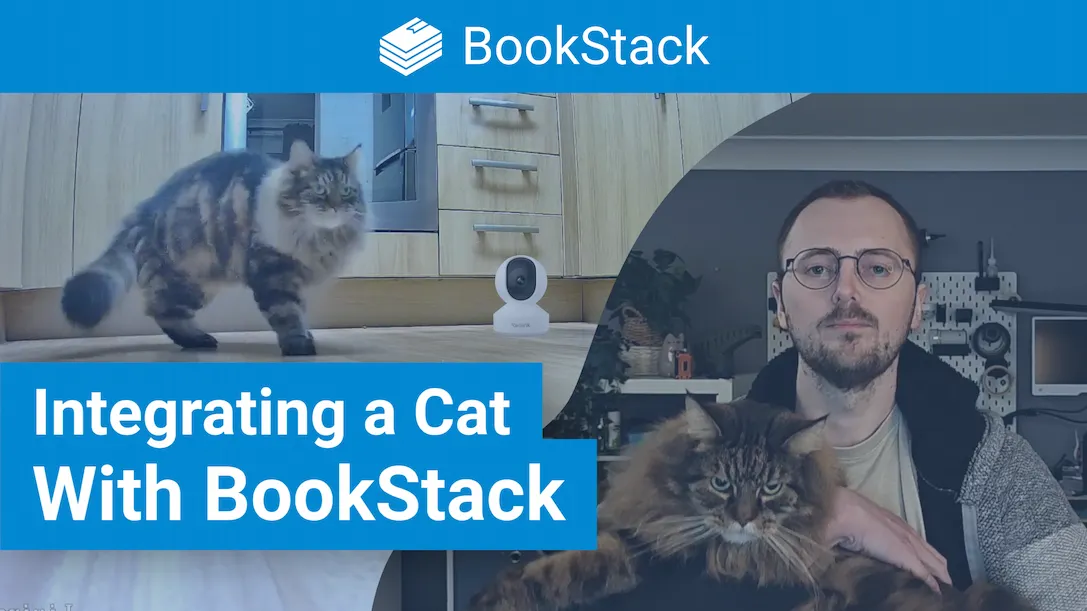
It’s a bit silly, but it’s all functionally valid so it might end up actually helping someone to integrate a meowie monster with BookStack.
Header Image Credits: Photo by Charles J. Sharp (CC-BY-SA-4) - Image Modified
_Cayo.jpg)