BookStack in 2025
 Dan Brown posted on the 2nd of January 2026
2025 has been a big year for BookStack, especially with us reaching a decade of BookStack back in July! As we jump into 2026 we’ll take this opportunity to look back at how the project has progressed over the last year:
Project Funding
First up we’ll take a look at what project revenue has been like throughout the year:
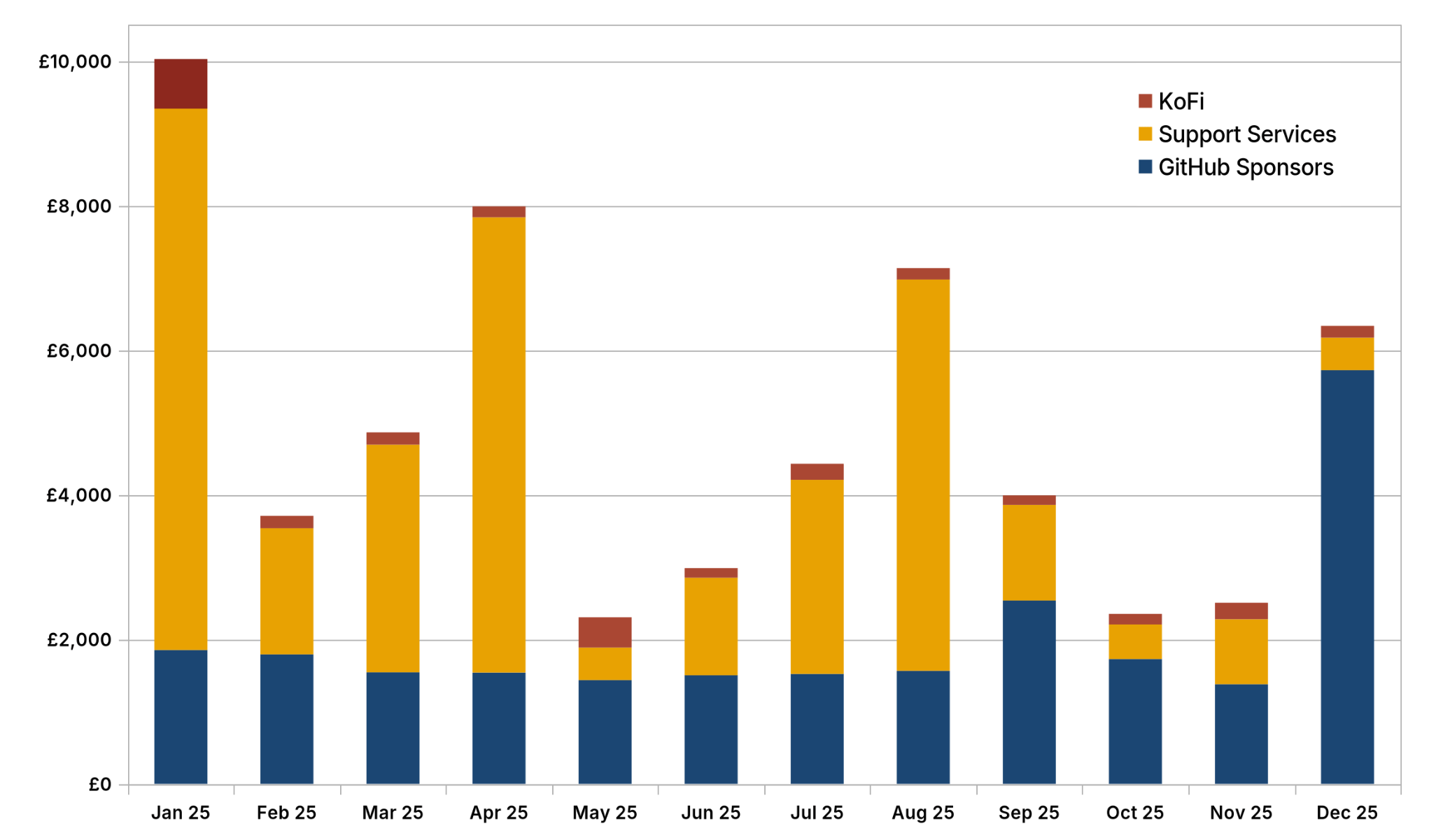
The base income via GitHub sponsors has grown, from a monthly average of about £1.4k to £2k. The overall rate of income via Ko-Fi is very similar to last year. Support service revenue has grown from a monthly average of £2.2k to £2.6k year-on-year. These changes mean overall income has risen from about £46.5k in 2024 to about £58.8k in 2025.
That jump in revenue provided via GitHub sponsors stands out, mostly helped by sponsors who have raised their existing sponsor tiers, and some new ongoing sponsors, in additional to a bunch of other donations from very kind folks. Our homepage is even starting to get a little crowded with 12 logos on display from commercial sponsors!
I’m happy to see that these figures have continued to grow by a significant amount with time, even with little outward promotion or change/development in regard to paid offerings. As mentioned in my decade of BookStack post the overall revenue (ignoring taxes and costs) is roughly equal to, or now more than, my yearly salary from my prior full-time senior developer job, which is incredible to me.
I want to reiterate my genuine thanks to all those who have contributed to this achievement in some way, whether that’s via donating, sponsoring, purchasing support, or even via simply spreading the word of BookStack. I am so lucky that BookStack has a very supporting community.
Sharing of Funds
Last year I wrote about how I had increased forwarding of donations to other open source projects, to support the libraries & projects which we rely on to develop BookStack. This is something I have continued, with my monthly GitHub sponsors bill increasing from $226 in December 2024 to $440 in December 2025. Upon that, from a rough tally, I’ve spent over £1k via various other means on open source services, projects and dependencies in addition to various groups which support open and free software rights.
For 2026 I hope to go further with this still, and expand donation forwarding further, especially since further revenue generation becomes more excessive relative to my own personal living costs & requirements.
New Features & Enhancements
In 2025 we’ve published 5 feature releases, and 18 patch releases of BookStack. Here’s a summary of the most significant additions and changes made over this year:
- User mentions in comments
- Proper content URL history system
- List count controls
- Automatic sorting with sort rules
- Internal reference handling on copy
- A major database restructure
- In-content comments
- Comment archiving
- Plaintext markdown input
- OIDC user avatar support
- AVIF image support
- Public files for the theme system
- Two underlying framework upgrades (Laravel 10 to 12)
- New WYSIWYG editor:
- Initial developer API
- Loads of fixes and improvements, moved to beta
- Production deployment for comments/descriptions
- API:
- Improved documentation navigation
- Comment endpoints
- Image data endpoints
- ZIP import/export endpoints
- System info endpoint
Reviewing the features listed, I’m happy to see an increase of more impactful features compared to last year, upon a range of changes I’ve been wanting to make for a while, with the major database restructure from November’s release being a good example.
Comments in particular stand-out since they’ve become a lot more powerful this year by gaining mentions, content referencing, archiving and a new editor.
I’m pleased that all of the listed features are focused on improving existing capabilities of the platform, improving things for existing users and use-cases instead of chasing new audiences with shiny new abilities. That’s a focus I try to retain to keep scope & maintenance reasonable, especially with BookStack being relatively mature at this stage, but we may branch out with brand new elements every so often.
Website Usage & Audience Reach
Once again we’ll review the traffic (tracked by a self-hosted Plausible CE instance) for our website relative to the previous year:
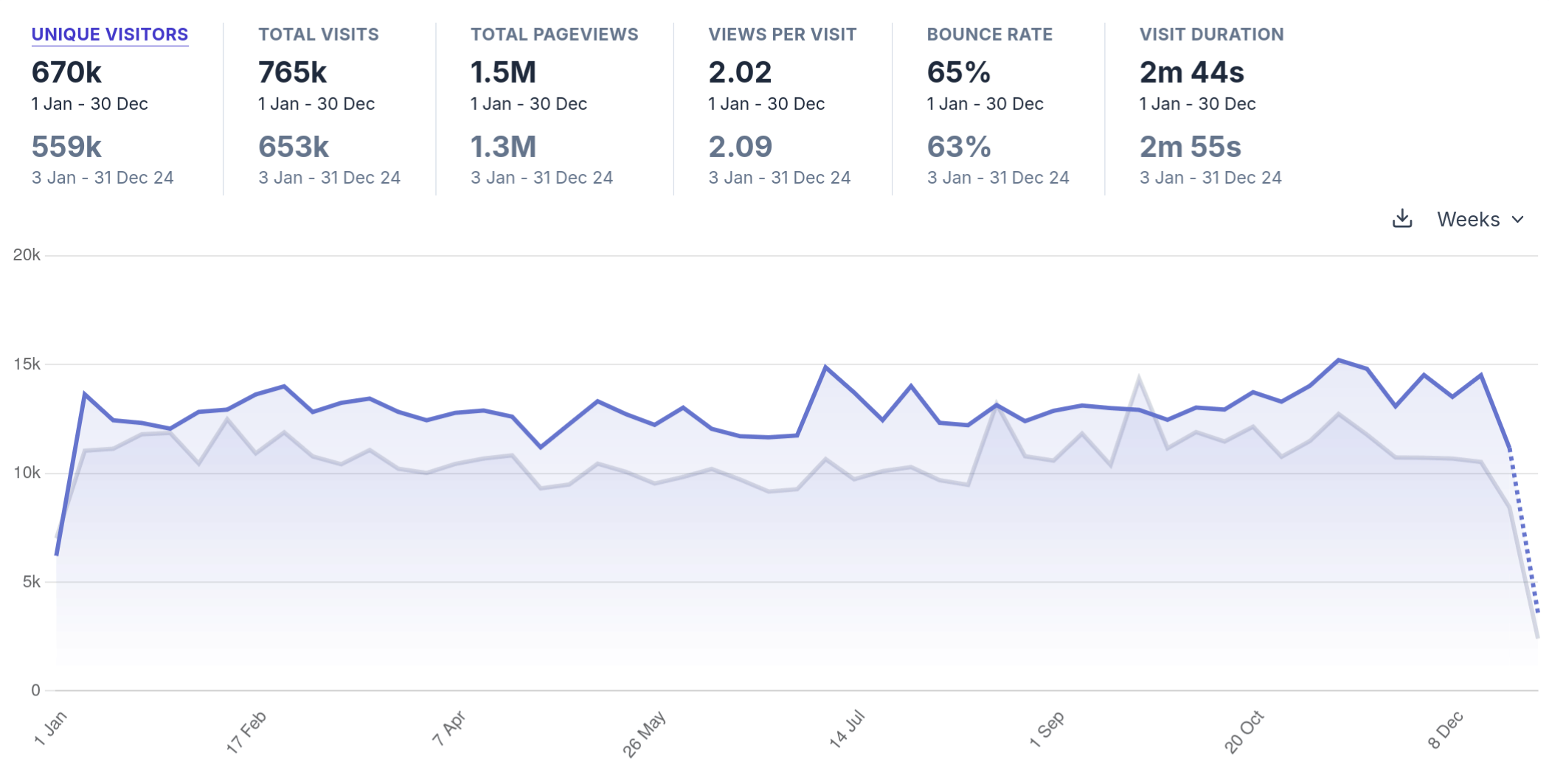
Like years before, we continue to see a 10 to 20 percent increase in traffic and visitors even though we’ve done very little outward promotion, which I’m rather pleased with. What I found more interesting this year are the traffic sources for the site:
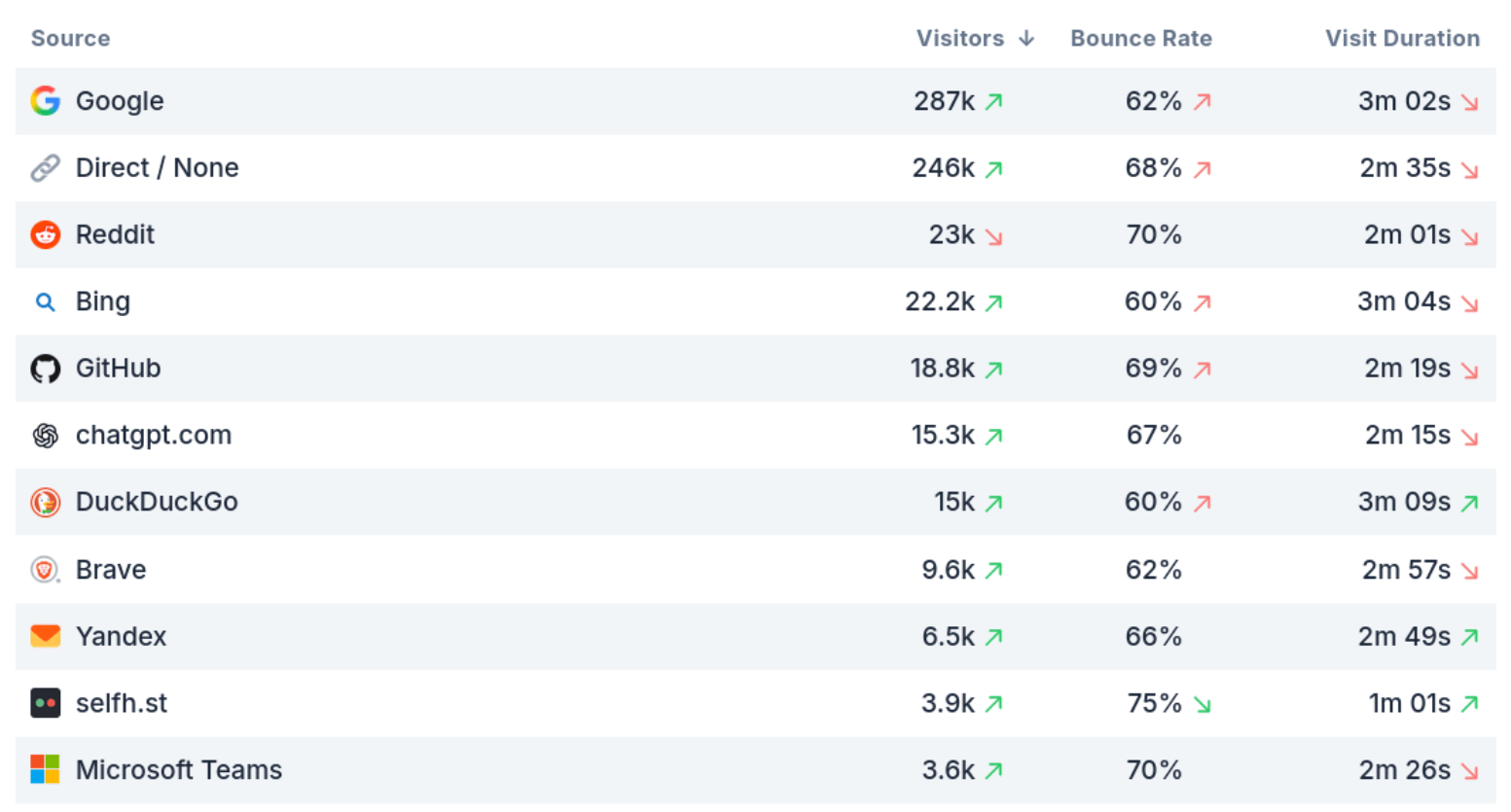
While traffic from traditional search engines is still up about 20% upon last year, other sources have seen a much bigger increase. Brave & Teams are up about 70% percent, but most notably ChatGPT is up 450%. Reddit is down 24% from last year. I feel these figures represent a shift in how people navigate and discover content on the web. We’ll have to check in on this next year to see if this trend accelerates, to then assess if we’d need to change how we promote the project.
Commitment to Open Source over Growth
It’s becoming increasingly common to see “enshittification”/decay affect open source projects, especially those which are web-based and able to generate revenue, so this has become a bigger concern for folks when selecting a platform to rely on.
Much related to this, earlier this year I formalized some of my prior efforts into a new site at isitreallyfoss.com to encourage transparency to users in the world of FOSS projects.
Here I want to demonstrate & re-iterate my commitment for BookStack in providing a solid complete offering under fully free and open source terms. It’s important to me that features, opportunities, or ideas are never locked away behind paywalls or non-FOSS licensing terms. I don’t want to lock users into a single vendor, it’s crucial to me that a community of offerings flourish around the project to allow user choice and prevent vendor lock-in. The desire for growth and revenue greed is so prevalent these days, but that’s not my interest. I’d much rather focus on providing an open platform with a slow and steady growth focused on our user-base. I don’t need to grow the project for the sake of growth, and to become rich, personally I’m just already over-the-moon about being able to have a comfortable income from open source work alone. I’ve hope the past 10 years proves my commitment to these ideals, and I intend to continue proving that for decades to come.
For 2026: The Move to Codeberg
Back in the September 2024 update I wrote about our migration to Codeberg from GitHub, and why we’re doing this. While all secondary project code repositories (like this website, hacks, scripts etc…) were quickly migrated, the main project repo stayed on GitHub due to being a much bigger beast.
I’ve come to the conclusion that there’s no ideal time to make this change for the main project, and therefore decided to just go ahead and migrate the main project in the next few weeks. This means that all pull requests, issues, and feature requests will be managed via a repo on Codeberg instead of GitHub. The GitHub repo will remain, to avoid broken links to a rich indexed history of useful information, but any new issues or PRs will be ignored, or likely auto-closed, if raised via GitHub. The GitHub repo will essentially act as a mirror of the codebase, which will prevent breaking changes to existing processes which pull from GitHub URLs. I’ll also continue to create release entries on GitHub alongside Codeberg for a while so that important updates are not missed, and to allow existing links & processes to be updated. Existing issues and PRs should be copied to the new Codeberg repository on creation, so they won’t be lost in the migration.
For production deployment usage, either GitHub or Codeberg could be used, but we won’t be suggesting either. Instead we’ve set-up a mirror at source.bookstackapp.com which we’ll document for installs & production environments. This is to reduce reliance on domains & services not under our control, and to allow easier change of source code management platforms in the future if needed.
Project management may be a little rocky during this migration time, especially for recent issues and PRs raised, but hopefully things will quickly stabilize on Codeberg.
For 2026: The Cyber Resilience Act
2026 is when we see some of the main obligations of the EU Cyber Resilience Act (CRA) come into play. While there are certain exceptions for open source, and even though I’m not in the EU myself (since Brexit), it appears the project will still be subject to the requirements of the CRA since I make money from the project, with many of my sponsors/donators/customers being in the EU themselves.
I’ve done some initial research on what this fully entails for BookStack, but I’ll probably be seeking expert legal advice in 2026 to fully understand what the CRA means for me and BookStack. Right now, it’s not too clear to me how the CRA would apply liability for the current set-up, where the project (along with donations/sponsors) are with me personally, whereas support services are provided via a separate limited company. Depending on requirements and advice, I may need to switch up the management/ownership structure of things.
If you know any legal experts with good knowledge of the CRA then please let me know of them!
Header Image Credits: Photo by Julian Herzog (CC-BY-4) - Image Modified
